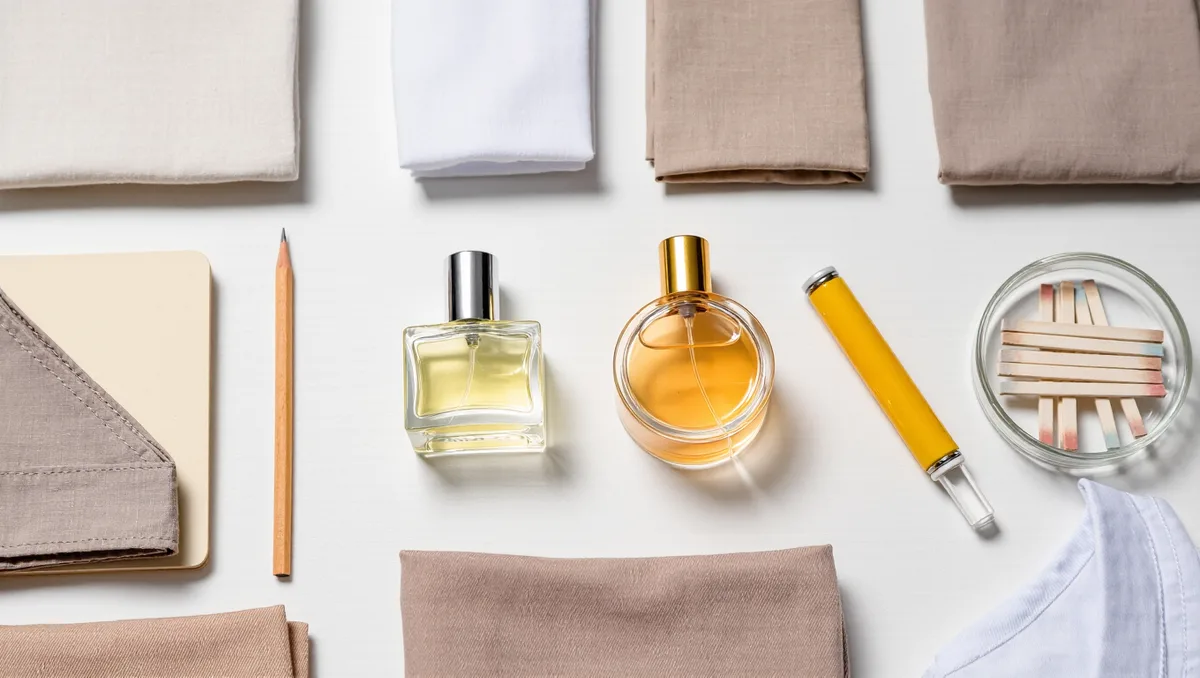
Most perfume regret comes from one mistake: buying a bottle after a single sniff on a paper strip. Learning how to test perfume properly takes a few days and costs almost nothing. The rule is simple — you wear a scent on your own skin, through a full day, before you pay for anything bigger than a sample.
The reason is chemistry, not snobbery. A fragrance changes as it dries. The bright opening fades within minutes, and what remains for the next several hours is the drydown, the part you will actually live with. Paper strips skip that part entirely, so a strip tells you what a perfume starts like, not what it ends like.
This guide walks through the full testing routine: where to get samples cheaply, what to do on skin day, and how to decide when a scent has earned a full bottle. If you are weighing a cheaper copy against the original, our guide on what you actually pay for with fragrance dupes vs originals covers the price side; this one covers the wear side.
Why a paper strip will mislead you
A department-store spritz on a blotter is a first date, not a marriage preview. Alcohol evaporates first, taking the volatile top notes with it in a burst that smells impressive for about ten minutes. Heart notes emerge next, and base notes — the musks, woods, and resins that linger on skin for hours — arrive last. A perfume you love at minute two can bore you by hour three, or the reverse: something harsh at first spray can settle into exactly what you want.
Community reviews make the same point in real time. On Fragrantica, the perfume database with roughly 141,000 entries and 2.6 million reader reviews, reviewers routinely describe scents that changed on them — one reviewer on the site noted a citrus-forward opening that settled into a warm vanilla within five minutes, while another wrote that a fragrance she initially hated became a favorite after months in the bottle. Both observations point the same direction: judgment too early is judgment wrong.
Strips still have a use. They are good for narrowing a field. Sniff ten strips at a counter, keep the two or three that interest you, and then test those properly on skin. Just never let a strip alone justify a purchase.
Where to get samples without spending much
You rarely need to buy a full bottle to learn a scent. Several routes cost little or nothing:
- Counter decants. Most fragrance counters will spray a blotter or fill a small sample vial on request. Ask directly; this is a normal request, not a favor.
- Discovery sets. Many brands sell sets of small vials, often with a voucher that credits back against a full bottle. Read the terms before you count on the credit.
- Decant sellers. Independent sellers portion full bottles into small sprays. Prices vary, so compare per-milliliter cost — the same math trap covered in our piece on when travel-size beauty costs more per ounce.
- Subscription samples. Monthly sample services rotate scents through your mailbox. Whether the math works depends on how many you actually finish; we ran the numbers in the beauty subscription box math after six months.
One caution on the secondhand route: a used bottle with no return option is the opposite of testing. Buy samples first, bottles second.
The skin test, step by step
Once you have a sample, give it a fair trial. Here is the routine:
- Pick a neutral day. No heavily scented lotion, no laundry-softener-heavy clothes. Competing scents corrupt the test.
- Spray once on clean skin. The inner forearm or the chest works. Skip the wrist-to-wrist rub — friction crushes the top notes.
- Smell at three checkpoints. Right after spraying, after an hour, and after four to six hours. Note what you think at each. Notes change; your notes should too.
- Wear it out. A scent behaves differently in an office, in humid weather, in your own coat. One full day of ordinary life tells you more than an hour at a counter.
- Repeat at least once. One wear is an impression. Two or three wears on different days is evidence.
Keep a small note — on your phone is fine — of what you smelled at each checkpoint. After a few tests you will see your own pattern: maybe you love every amber drydown and hate every sharp citrus opening. That pattern is worth more than any reviewer's verdict, because it is yours. Readers following this should also see Beauty subscription boxes: the math after six months.
What this means for your budget
Our analysis: the testing routine exists to protect one purchase, the full bottle, and full bottles are where fragrance pricing gets steep. A designer eau de parfum commonly runs well into three figures; niche houses charge more. Against that, samples and decants cost a few dollars each. Even a disciplined tester who buys ten samples before committing has spent a fraction of one wrong bottle.
The other budget lever is size. If you love a scent but wear perfume only a few times a week, a smaller format may serve you better — with the same per-ounce caution as any mini. And if a scent passes every test and you still balk at the price, that is the moment to read the dupe comparison, because a copy that matches the drydown you love may be the rational buy. A copy that matches only the opening is not. We covered a connected angle in Travel-size beauty: when the mini costs more per ounce.
One more thing samples reveal: how much you actually reach for a scent. A bottle you spray twice a month costs far more per wear than its sticker price suggests. Testing tells you not just whether you like a perfume, but how often you would wear it — which is the number that decides whether any price is worth it.
When to commit to the full bottle
Commit when three things line up. First, you have worn it at least twice on full days and still like the drydown. Second, you have caught yourself reaching for the sample without prompting — genuine pull, not politeness to a purchase. Third, the price at the retailer you trust is one you have checked, because fragrance prices move and discounts expire; whatever figure you find, date it and expect it to change.
If any of the three is missing, buy another sample or a small size and keep testing. A shelf of half-loved bottles is the tax you pay for skipping this step. A few dollars of samples is the way to never pay it.
Final thoughts
Testing perfume is not a ritual for experts. It is three checkpoints on your own skin, a short note, and a repeat wear. The evidence from millions of reader reviews on Fragrantica and from any tester's own shelf says the same thing: scents change, and early impressions lie. Sample first, wear it through the drydown, and buy the bottle only when the third hour still makes you happy.