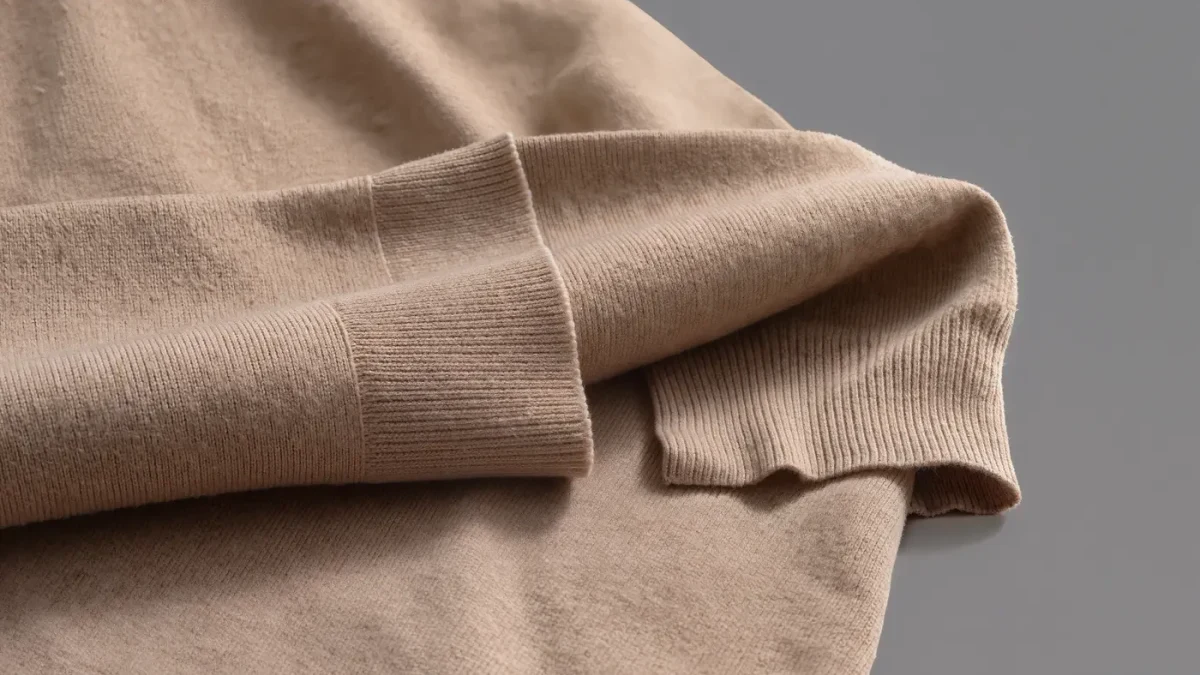
A $140 sweater earns its price — or doesn't — through three things you can check in the store in under two minutes: the fiber on the label, the density of the knit, and the finishing at the seams. The $40 sweater is not a scam; it is a different product built to a different life expectancy. What follows is how to tell which signals actually predict whether a sweater survives three winters or three washes.
Start with the label, because the law makes it informative. Under the Wool Products Labeling Act of 1939, wool products sold in the US must carry accurate fiber content, and the FTC enforces it — so "100% merino" on the tag is a regulated claim, not marketing copy. The price gap between a $40 acrylic blend and a $140 wool sweater is largely a raw material story: wool fiber costs more than acrylic by the pound, and long-staple fine wools cost more still.
What does fiber content tell you about quality?
Fiber predicts warmth, pilling, and lifespan more than any other single attribute. Wool and cashmere regulate temperature and resist odor but need careful washing; cotton is durable and washable but cold when damp; acrylic and polyester are cheap, machine-washable, and prone to pilling and heat damage. Blends are not automatically bad — a wool-nylon blend adds strength to socks, and a touch of elastane holds shape in fitted knits. The signal to distrust is a tag leading with "cashmere feel" or "wool touch" while the fiber list opens with acrylic: you are paying for a texture claim on a synthetic base.
How do you judge knit density in the store?
Stretch test and light test. Pull the fabric between your fingers: dense knits spring back and you can barely see through them; loose knits gape and recover slowly, which means sagging elbows and stretched hems within a season. Hold it up to a light — a $140 sweater should show a tight, even structure, while visible gaps between stitches at the same gauge suggest the maker saved yarn. Weight matters too: compare two sweaters of the same size and fiber by hand. More fabric per garment costs more to make, so an implausibly light "wool" sweater at a wool price deserves suspicion.
Which construction details separate $40 from $140?
- Seams. Turn the sweater inside out. Overlocked serged seams that scrunch into ridges are the budget default; flat-joined or linked seams lie smooth and are standard on better knitwear.
- Collar and cuffs. Ribbing should feel tight and springy; loose, wavy ribbing loses grip fast.
- Yarn evenness. Run a hand over the knit — slubs and thin patches signal cheap spinning or relaxed quality control.
- Finishing. Look for hand-finished necklines and reinforced underarm panels at the premium end; at $40 expect none of this, and that is how the price happens.
- Extra yarn in seams and hems. Makers of durable sweaters leave yarn allowance for repairs; fast-fashion knits are cut to the millimeter.
Is the $140 sweater automatically the better buy?
No, and this is where cost per wear does the thinking. A $140 merino sweater worn 60 times a year for four winters costs well under $1 per wear — an example calculation, not market data — while a $40 acrylic worn ten times then binned when it pills costs $4 per wear. But flip the scenario: for a trendy silhouette you will wear one season, the $40 version is the rational pick, and some $40 sweaters are genuinely well made in dense cotton or sturdy blends. The price tag predicts nothing by itself; the fiber, density, and seams do. Compare a $40 and $140 sweater on those three signals and you will usually see exactly where the money went.
| Signal | Typical $40 sweater | Typical $140 sweater |
|---|---|---|
| Fiber | Acrylic or cotton-poly blend | Merino, lambswool, cashmere, or blend |
| Density | Loose knit, gaps visible to light | Tight gauge, springs back after stretch |
| Seams | Serged, ridged inside | Linked or flat-joined, smooth inside |
| Expected life | 1–2 seasons | 5+ years with care |
The table describes typical patterns observed across US retail as of 2025; individual garments vary, and prices are subject to change.
The bottom line
Check the label first, stretch and light-test the knit second, and turn it inside out before you pay. Those three checks cost nothing and reveal more than the price tag does. Skip any sweater — at either price — that pills in the store's display sample, because a season of wear only accelerates what the hanger has already shown you.
How much does care change the quality math?
Care requirements are part of the price, and they are the part people forget. Wool and cashmere at the $140 level reward hand washing or a wool cycle, drying flat, and folded storage — a few minutes per wash and a drawer instead of a hanger. Treat a good wool sweater like a t-shirt and you will convert it into a $140 doll's garment in one hot dryer cycle, which is a real risk with machine-washing habits built on synthetics. Acrylic's genuine advantage is forgiveness: it survives washer, dryer, and neglect, which matters more than fiber snobbery admits for parents, travelers, and anyone who launders in bulk.
Run the numbers honestly (example calculation): a $140 merino sweater that needs, say, five careful washes a season costs you perhaps fifteen minutes of attention a month — but if you know you will not do it, that sweater is the wrong purchase regardless of its quality signals, because its rated lifespan assumes care it will not receive. Meanwhile a pilling-prone fiber has a partial fix that many shoppers skip: a cheap fabric shaver revives pilled knits several seasons in a row, which narrows the gap between a well-chosen budget sweater and its premium counterpart. The decision rule: buy the high-maintenance fiber only when your actual laundry behavior matches its requirements; otherwise optimize for durability and plan to de-pill. Quality you cannot maintain is not quality you own.
For more context, read When the cheap version is the smarter purchase.
For more context, read How to tell if that “was” price is actually real.
For more context, read Check resale prices before you buy retail.