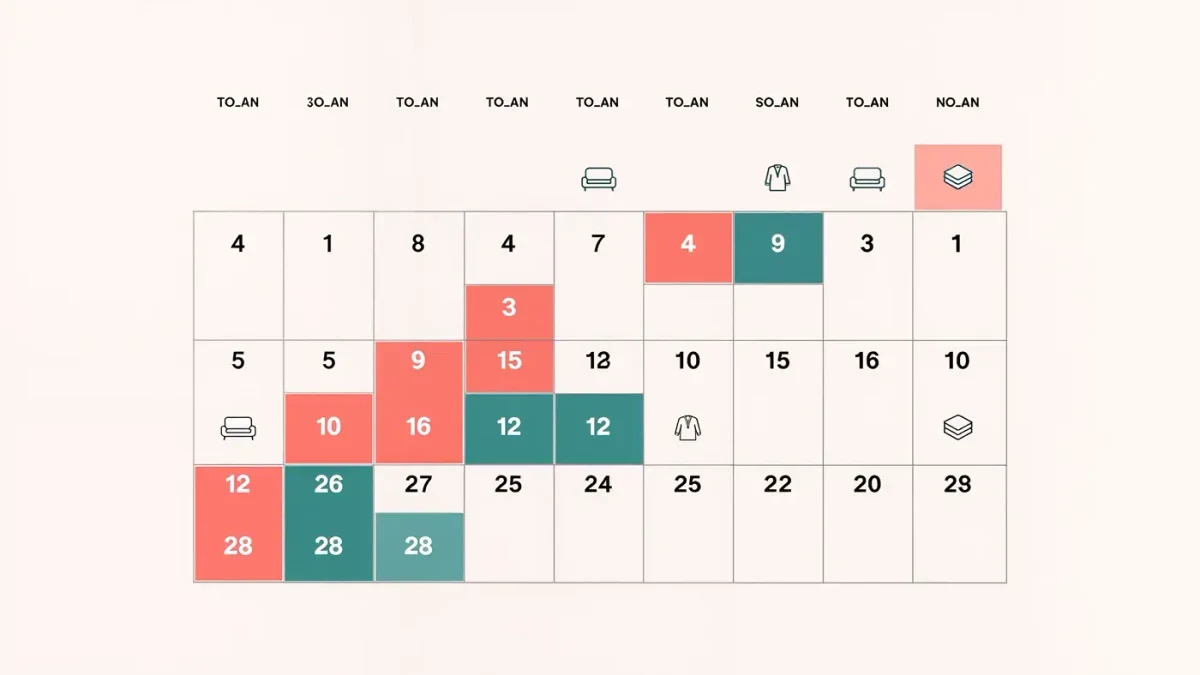
The retail calendar is the closest thing shopping has to a timetable: certain categories reliably hit their deepest discounts in the same weeks every year, because retailers clear floor space on a fixed rhythm regardless of what shoppers want that week. Linens go on sale in January (the traditional "white sales"), furniture in July, appliances around holiday weekends, and winter coats in late January and February once the season's demand has passed. Buy against the calendar and the same item costs measurably less; buy off-schedule and you pay the shelf for the convenience.
The mechanism is inventory, not generosity. Retailers plan markdowns around seasonal turnover - when summer goods must vacate the floor for fall, prices fall with them. The calendar below reflects long-standing US promotional patterns (as observed across major retailers, 2019–2025); specific dates and depths vary by store and year, and everything here is subject to change.
What goes on sale when?
| Window | Reliable markdowns | Why |
|---|---|---|
| January | Linens and bedding ("white sales"), winter clothing clearance | Post-holiday reset; winter demand ending |
| February (Presidents' Day) | Appliances, mattresses, winter clearance | Major promo weekend; floor turnover |
| May (Memorial Day) | Mattresses, furniture, appliances, spring apparel | Kickoff of summer promo season |
| July (Fourth of July) | Furniture, outdoor gear, summer apparel | Mid-summer clearance push |
| August–September | Back-to-school goods, summer leftovers, Labor Day appliances | Seasonal transition |
| November (Black Friday/Cyber Monday) | Electronics, small appliances, doorbuster categories | Volume weekend; loss-leader pricing |
| Late December–early January | Holiday goods, winter apparel at final clearance | Space for spring arrivals |
Holiday-season spending concentrates heavily into November and December (the National Retail Federation has tracked this pattern for decades), which is why Black Friday discounts are broad but not always deep - the volume weekend rewards retailers even at thinner margins, and some "sale" prices simply reset to levels seen earlier in the year. Price-history checking remains the calendar's essential companion.
Which purchases reward timing most?
- Seasonal clothing. Winter coats and boots bought in late January or February routinely land 50–70 percent below their November prices (typical clearance depths observed at major US retailers, 2019–2025). The catch is selection: by final clearance you get the leftovers, in popular sizes first.
- Furniture and mattresses. Holiday weekends - Presidents' Day, Memorial Day, July Fourth, Labor Day - carry the year's heaviest furniture promotions, often with free-delivery stacking on top.
- Appliances. Holiday weekends plus October–November (new-model turnover) are the reliable windows.
- Electronics. Black Friday and back-to-school periods, with the caveat that doorbuster models are often derivative - check whether the discounted SKU matches the spec sheet of the model you researched.
- Linen and bedding. January white sales remain a genuine fixture decades after department stores invented them.
What does the calendar get wrong?
Three limitations keep it honest rather than automatic. First, timing only matters for items you actually need - waiting three months for a coat discount fails if you freeze in December, and the calendar never justifies a purchase, only its price. Second, clearance selection is what survives: buying at the right time often means choosing from what did not sell, so size and color flexibility are part of the price you pay. Third, online retail has blurred the calendar - prices now move daily, and a poorly timed week can be rescued by a price-tracking tool or a retailer's own price adjustment policy if you have already bought. The calendar sets the odds; it does not guarantee the outcome.
How do you use the calendar without becoming its victim?
Keep a running list of what you genuinely need with target windows next to each item, then let the calendar come to you: coats in late winter, furniture on Memorial Day or the Fourth of July, linens in January, electronics on Black Friday only after verifying the model is one you would buy at full price. The list converts the calendar from an invitation to shop into a schedule for waiting - which is the entire value. The shopper who knows that July is furniture month and does nothing until the list contains furniture has captured the calendar's benefit without paying its tax: buying things because they are on sale rather than because they are needed.
The bottom line
Time the category, verify the price, and keep the list in charge. The retail calendar is public information that most shoppers ignore, and its edge compounds: the same winter coat at January clearance, the same mattress on Memorial Day, the same sheets in the white sale - each is an identical product at a materially different price. Prices, promotional dates, and discount depths are subject to change; the rhythm, historically, is not.
How do you combine the calendar with price tracking?
The calendar tells you when discounts are likely; price-history tools tell you whether a specific price is actually good. Use both, in that order: pick the category's window from the calendar, then verify with a price tracker or your own notes from past months before committing. This pairing defeats the calendar's main failure mode — the promotional price that equals last quarter's everyday price. It also catches the inverse, when a genuine deal appears off-calendar and the disciplined move is to buy immediately rather than wait for the "correct" month; the calendar is a probability, and a verified low is a fact. For big-ticket items, set tracker alerts at your target price during the right window and let the notification do the patience for you. And keep records of what you actually paid: after one full year of notes, you will have a personal calendar calibrated to your stores and sizes, which beats any generic month-by-month chart — including the one above. The goal is not encyclopedic timing; it is knowing, for the ten or fifteen categories that dominate your spending, which weeks reward the wait.
For more context, read How to tell if that “was” price is actually real.
For more context, read resale before buying.
For more context, read Stacking cashback, coupons, and sale prices correctly.